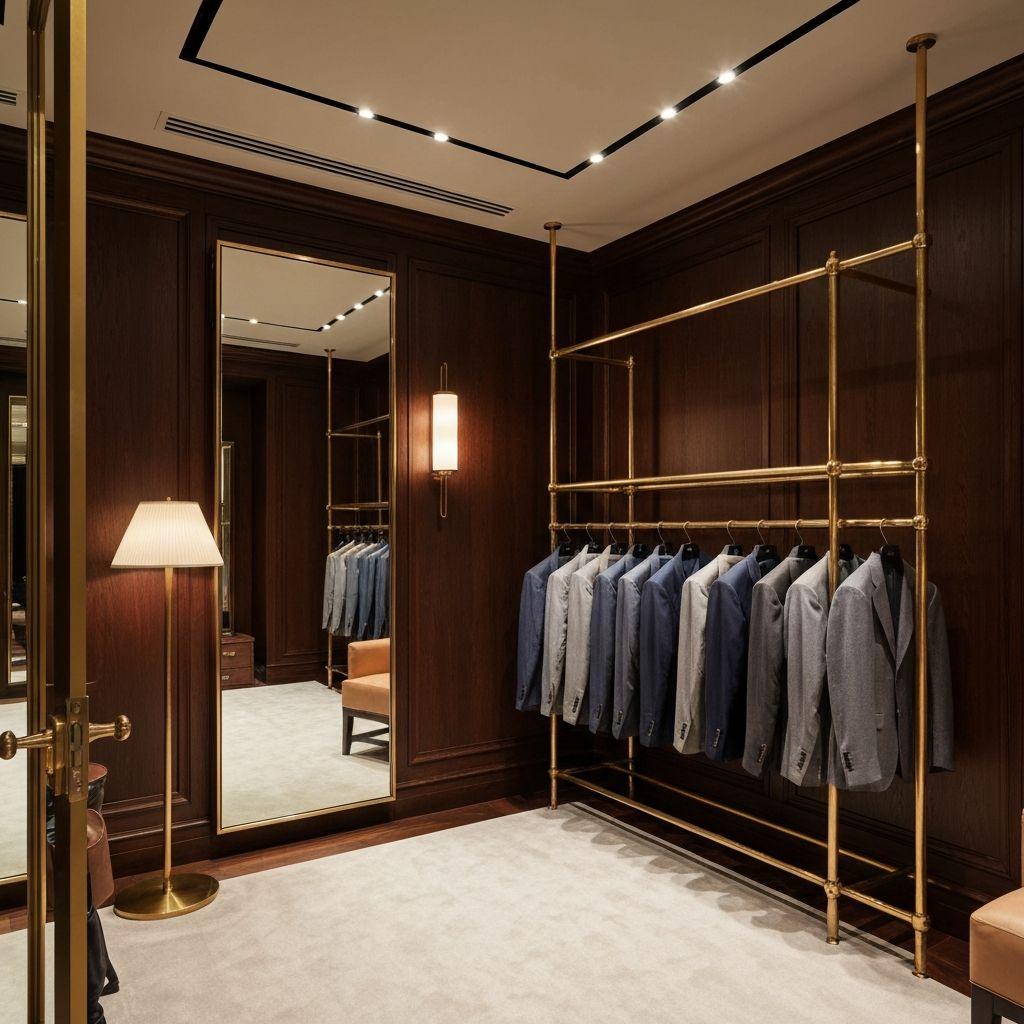
Most men assume a bespoke suit begins with picking cloth and agreeing a price. The decisions that actually determine whether it fits are made afterwards, in a workroom you will never see. What happens in the fitting room is only the briefing.
The first visit is a consultation, not an order
You sit down, we make tea, and nobody reaches for a bunch. The first question is what the suit is for: an interview, a boardroom, a wedding, or a job you will wear it to five days a week. The same body needs different shoulders for a wedding and for a desk. A groom stands for ten hours and is photographed from every angle, so the shoulder line has to hold. A man who sits in meetings all day needs room through the back, or the jacket pulls the moment he leans forward.
Then the measuring. More than thirty dimensions: neck, chest, back length, armhole, rise, the angle of the trouser hem. The number of measurements is not the point. The notes beside them are. How far the shoulders slope. Whether one sits higher than the other. Whether the waist is tipped forward or the pelvis tucked under. Whether the client stands with a slight stoop. In Hong Kong, years at a desk leave most men with the head carried forward and the shoulders rounded. Ignore that and the jacket looks excellent on the hanger and hollow at the collar the moment it goes on.
We keep the profile. A second commission starts from your last one rather than from scratch, adjusted for whatever has changed. Some clients come back a decade later and the file is still there.
Cloth: weight before colour
The library runs to several thousand cloths — Zegna, Loro Piana, Scabal, Holland & Sherry, Vitale Barberis Canonico, and others from Italian and British mills. New clients start with colour. I start with weight, because weight is what you will feel at three in the afternoon in July.
For a Hong Kong summer, a wool around 250–280g is the practical choice. It breathes, it drapes, and it does not go translucent under office lighting. For winter, or for a client who travels, 320g and up holds a cleaner line, though anyone wearing it all day here usually prefers the lighter cloth. An outdoor wedding is its own problem: something in between, and a spare shirt.
When a bunch says Super 150s or 180s, that is the fineness of the yarn, not its durability. Finer cloth is smoother and lighter and also more fragile. If the suit will be worn daily and folded into a taxi, there is no virtue in chasing the highest number. There is no best cloth, only the right one for the six to eight weeks you are buying it for.
The pattern is drawn for one body
Your measurements go to the pattern room, where a cutter draws a new pattern from your numbers rather than adjusting a block. Your shoulder slope, the curve of your back, the set of your waist and any asymmetry are built into the paper. Before the cloth is cut, the pieces are laid with the grain, and stripes and checks are matched so that the pattern runs continuously from sleeve to body and across the pocket flaps. A mismatch there is the first thing anyone notices, even if they cannot say why.
This stage takes the longest and shows the least. You will receive a suit, not a pattern. But whether the jacket sits cleanly or fights you when you sit down is largely settled here.
The baste fitting is not optional
Two or three weeks in, you are shown a half-made garment held together with loose white stitches. No lining, no buttons, the collar and sleeves only tacked in place. This is the baste.
It is the most valuable hour of the whole commission. The shoulder line can be moved, the collar re-set, the armhole taken in, the back let out. Discover a wrong shoulder after the lining is in and the buttons are on, and you are no longer tailoring a suit; you are rescuing one. A rescue never looks as good as a garment that was right the first time.
Come in the shirt and shoes you will actually wear with it, not trainers. The cuff should show about half an inch of shirt; the trouser should break gently on the shoe. Walk, sit, reach across the table, sign an imaginary cheque. We watch where the cloth moves and where it pulls.
Alterations and the second fitting
The baste is taken apart, the pattern corrected, the cloth re-cut where necessary, and you are seen again. Most clients need two fittings. A difficult shoulder or a body that has changed during the wait may need a third. That is not slowness; it is a refusal to deliver something approximately right.
Delivery: six to eight weeks, and fifty to seventy hours of handwork
True bespoke runs six to eight weeks from first measurement to collection. A suit represents fifty to seventy hours of handwork: basting, attaching the canvas, working the lapel, setting the sleeves, the buttonholes. Much of it cannot be done by machine, and the parts that can are often better done by hand.
On collection day we ask you to put it on once more and move around in it. A suit is finished on the body, not on the hanger. Small adjustments at that point are normal and we would rather do them than have you discover the problem at the wedding.
What is sold as bespoke but is only alteration
Plenty of shops now advertise bespoke at very different prices. A few questions separate the two:
- How many measurements? Chest, waist, sleeve and leg length only usually means a stock size is being adjusted.
- Is there a fitting? If the garment is already finished and you are asked to turn around in front of a mirror, that is a try-on, not a fitting.
- Is there a pattern in your name? Altering a factory block and drawing from your body are different trades.
- Does the quote mention construction? Half-canvas, full floating canvas, or fused, changes both the price and the life of the jacket.
None of this makes alteration dishonest. If your body is close to a stock size, altering a good ready-made suit is sensible and quick. But if you are paying bespoke money, you should be buying a pattern, a fitting, and a tailor who remembers which shoulder is lower.
Where to start
If you have never commissioned a suit, come and sit down once. Look at cloth, ask questions, and leave without ordering if you are not ready. The full sequence is set out on our tailoring process page, and the cloths and house styles for men are on bespoke suits. To book, contact the atelier — Hankow Road, Tsim Sha Tsui, a minute from The Peninsula.