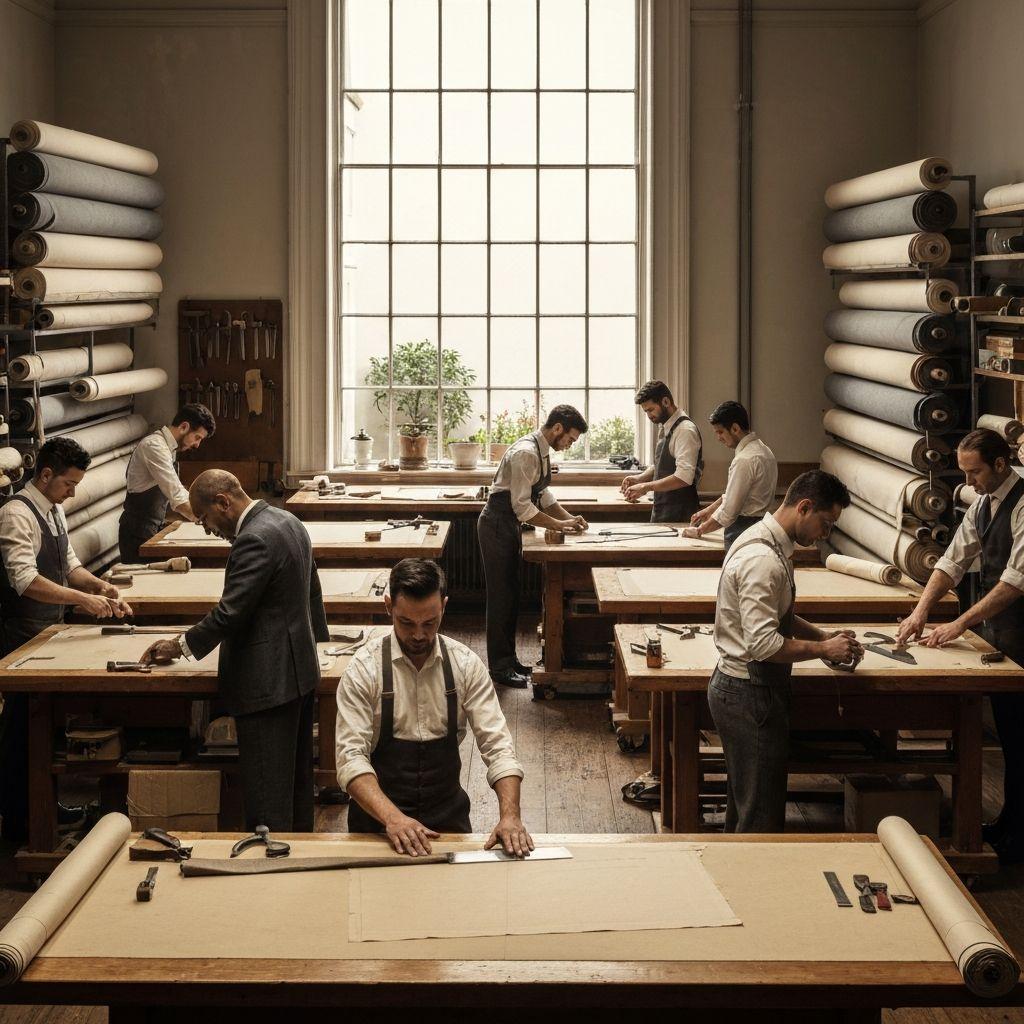
Most people who walk into a Hong Kong tailoring shop cannot tell what they are looking at. The windows look alike, the cloth books look expensive, and one quoted price is hard to compare with the next. What follows explains what happens inside a workshop that has been cutting for clients since 1962, for the reader who has already paid for a suit somewhere and been quietly disappointed.
The first question is who cuts the pattern
Ask any shop this before you discuss cloth. There are two answers, and only one of them is bespoke. A made-to-measure garment begins with an existing block pattern, graded up or down to your nominal size and adjusted at a few points. A bespoke garment begins with blank paper and a pencil.
At our shop the cutter takes more than thirty measurements. The interesting ones are not the numbers but the notes beside them: which shoulder drops, how far the chest sits forward of the hips, whether the client stands with weight on one leg. A tape measure records a body; it does not record a posture. Those notes are what a pattern is built from.
The pattern is then cut by hand, marked, and kept. Not digitised and filed under a size, but drawn for one person and stored for the next order.
What a hand-cut pattern changes on the finished suit
Three things, all visible once you know where to look.
- Grain. Cloth has a direction. Cut slightly off grain and the trouser leg twists around the shin by the end of the day. Hand cutting lets the cutter follow the weave rather than a stack of layers.
- Pattern matching. A stripe should run continuously through the shoulder seam, the sleeve head, the pocket flap and the centre back. On a check, the line should break as little as possible. A factory cutting forty layers at once cannot place the pattern for one client's shoulder.
- Balance. Front length against back length, the angle of the sleeve, where the waist sits. These are corrected on paper before cloth is cut, which is cheaper than correcting them on a finished jacket.
The canvas is the part you cannot see
Inside the chest of a proper jacket is a layer of wool and hair canvas, attached with thousands of small hand stitches and left floating, able to move independently of the outer cloth. It gives a jacket shape without stiffness, and lets it mould to the wearer over a few months.
The alternative is a fusible: a glue-coated interlining pressed on with heat. It is faster, cheaper, and looks perfectly acceptable in the shop. In Hong Kong humidity it is also the usual reason a jacket starts to bubble across the chest after a year or two, and once a fusible separates, nothing can be done.
There is a crude test. Pinch the cloth an inch below the lapel. A fused front feels flat and papery, like two sheets stuck together; a canvassed front has give, and a slightly uneven spring where the stitches are. Run your thumb along the lapel roll: on a hand-stitched lapel the curve wanders a little, because a person made it.
Why we still baste before we sew
The first fitting is not a finished suit with pins in it. It is a baste: the pieces tacked with loose white stitches, no lining, no buttonholes, still open to being taken apart. You put it on, stand, sit, walk across the room. The cutter marks in chalk what has to change, then the garment is unpicked and re-cut.
That is the point of it. A suit that skips the baste has already committed to its shape before it has met your body. The second fitting is closer; the final is a suit you can wear out of the shop.
A true bespoke suit takes fifty to seventy hours of hand work, spread across six to eight weeks. Made-to-measure, which starts from a block pattern, takes three to four weeks. If a shop promises a fully hand-canvassed suit in ten days, ask who is doing the sewing.
Cloth is a decision, not an upgrade
We work with Ermenegildo Zegna, Loro Piana, Scabal, Holland & Sherry, Reda and Vitale Barberis Canonico, the Italian mill weaving since 1910, whose bunches run from Super 150s to 180s. The library holds several thousand cloths, which is more a problem than a selling point: too much choice is how a first commission goes wrong.
The useful conversation is about weight and use, not prestige. For a suit worn in a Hong Kong summer, 250 to 280 grams is comfortable and still holds a crease. For winter, or for a client who travels, 320 grams and up drapes better and wrinkles less in a suitcase. A very fine Super 150s feels extraordinary in the hand and wears thin at the seat and elbows if it is the only suit you own. Most of our long-standing clients end up with something mid-weight for weekly wear and save the fine cloth for occasions.
The file with your name on it
Repeat clients are the real test of a tailoring house, because a second order tells you whether anyone paid attention the first time. We keep a fitting profile for every client: measurements, posture notes, what changed at the second fitting, the cloth, the date. The next commission starts from a body we already know instead of a fresh guess.
If you are comparing tailors, ask whether your pattern is kept, then ask to see it. A pattern in a drawer with a name and a date on it is a different object from a note on a screen saying regular fit, size 40.
A workshop you can walk into
Ours is on the ground floor of Hankow Centre, 5 to 15 Hankow Road in Tsim Sha Tsui, a minute from The Peninsula, the Kowloon Hotel and the Langham. Cutting tables, cloth shelves, irons and the cutter who will make your pattern are in the same room. Weekdays run 09:00 to 19:30, Saturday 10:00 to 18:00, Sunday and public holidays by appointment. A first consultation is a private hour with tea or coffee, with no obligation to order. For clients who cannot come to Hong Kong, master tailors travel on trunk shows through the year.
Five questions worth asking before a deposit
- Who cuts the pattern, and can I meet him?
- Is the chest canvassed or fused, and can I feel the difference?
- How many fittings are included, and is the first one a baste?
- If the shoulders are still wrong at the final fitting, what happens?
- Where is the garment actually made, and by whom?
A shop that answers these plainly is worth a second visit. One that deflects them is telling you something too.
If you want to see the difference rather than read about it, read more about the atelier, look at how a commission runs from first measurement to final fitting, or go straight to our bespoke suits. Book a fitting at our Tsim Sha Tsui atelier through the contact page, and bring the suit you were disappointed by. It is a useful place to start.