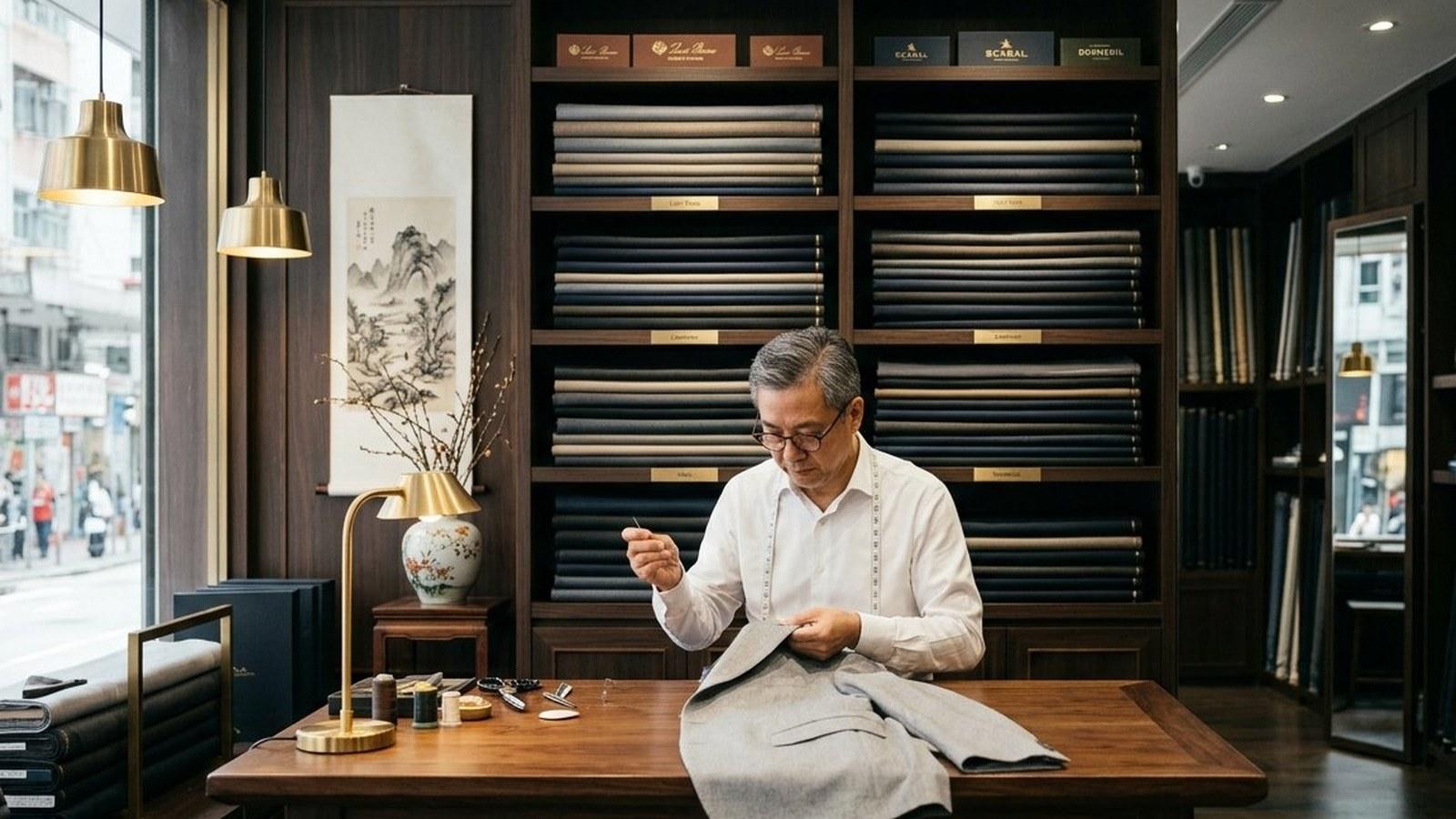
For a first commission, order a single-breasted suit in navy or charcoal, choose cloth around 250–280g for Hong Kong, and put your money into the shoulder and the fit rather than trend details. Expect two or three fittings and six to eight weeks. That is the short answer; the rest is how we explain it across the counter at our Tsim Sha Tsui atelier.
What should your first suit be, navy or charcoal?
Navy or charcoal, not black. Navy is the warmer of the two and sits comfortably in a banking office, a wedding and a dinner. Charcoal is a little more formal and photographs well under office lighting. Either will carry you through an interview, a client meeting and a friend's wedding without announcing itself.
Black is best kept for funerals and evening dress. Light grey, beige and strong patterns are harder to wear repeatedly, and a first suit should be the one you reach for without thinking. If you genuinely need one suit only, pick the colour that matches the rooms you stand in most. For most Hong Kong men that is navy.
Keep the details quiet: a two-button front, notch lapels, flap pockets, a plain lining. Those choices do not date, and they let the fit do the talking. A first bespoke commission is not the place for a peaked lapel experiment.
How heavy should the cloth be for Hong Kong?
For most of the year, 250–280g wool is the useful range. It is light enough to wear through a humid afternoon, heavy enough to hang cleanly and shed the creases that come from sitting at a desk. An open-weave or high-twist cloth helps more than a low number on the label.
Below about 230g, cloth can turn shiny at the seat and elbows and lose its shape on the shoulder. Above 320g, it is a winter suit or a suit for a heavily air-conditioned office. Neither is wrong; they are simply different garments. If you travel for work, a mid-weight cloth in a plain weave is the more adaptable purchase.
Ask to see how a cloth behaves, not just how it feels. A swatch in the hand tells you softness; a length on the table tells you drape. We keep a library of cloths from Zegna, Loro Piana, Scabal, Holland & Sherry and VBC, and we will show you the difference rather than push the most expensive bunches.
What do the shoulder and sleeve pitch actually do?
The shoulder is the foundation of the suit. It has to sit on your natural shoulder line, allow for slope and asymmetry, and stay put when you move. We take more than thirty measurements per client, including posture and shoulder notes, because a shoulder cut for an average figure will pull or collapse on a real one.
Sleeve pitch is the angle at which the sleeve head is set into the armhole. Get it wrong and the sleeve twists, the back of the arm creases, and the cuff rides up whenever you reach forward. At the fitting, stand as you normally stand and let your arms hang. Do not stiffen or square your shoulders for the tailor; the suit will be cut for that pose, not for your life.
Sleeve length matters too. The cuff of your shirt should show a little at the wrist, and the jacket sleeve should follow the arm's natural curve. We check this with the shirt you will actually wear, not a fitting shirt from the rail.
Single-breasted or double-breasted for a first suit?
Single-breasted, two-button, for the first suit. It is more versatile, easier to wear open, and more forgiving if your weight or posture changes. A double-breasted six-on-two is a handsome garment, but it is a stronger statement, it takes more cloth, and it usually needs more fitting attention around the chest and waist.
A double-breasted suit is a good second commission, once you know how you like a jacket to sit. For the first, keep the lapel notch and the front single. You can add a peak lapel later without rebuilding your entire wardrobe.
How many fittings should you expect?
True bespoke usually runs to two or three fittings. The first baste checks balance, shoulder, length and the general line of the jacket. The second fitting refines the chest, the sleeve pitch and the trousers. The final fitting is for small corrections, button stance and hem. Six to eight weeks is the normal lead time; made-to-measure is quicker, at three to four weeks, with fewer fittings.
Do not compress the schedule because a wedding is close. A suit that is rushed through the first baste will still show it at the shoulder. Book with enough margin to allow a second fitting, and bring the shoes and shirt you intend to wear so the trouser break and sleeve length are judged properly.
What should you not spend on first time?
Skip the trend details. Extreme lapels, contrast stitching, unusual pocket shapes, visible monograms and fashion linings all date quickly, and they are the first things a tailor has to talk you out of. Spend on the cloth, the canvas and the fittings instead.
Do not order extra trousers before you know how the first pair fits. Trousers are the part of a suit most likely to need adjustment after a few wears, and a second pair cut to a fit you have not yet tested is money spent too early. Wear the suit for a month, then decide.
Do not buy two suits at once either. One good navy or charcoal suit teaches you what you like: the shoulder line, the amount of waist suppression, the trouser rise. The second suit is easier and better once you have worn the first.
What should you ask before paying a deposit?
Ask who cuts the pattern and who sews the garment. Ask whether the workshop is true bespoke or made-to-measure, and how many fittings are included. Ask what the quoted price covers: alterations, extra trousers, a second pair of sleeves, delivery. Ask what happens if the fit is not right after the final fitting.
Ask to see examples of the house style, and ask how long the tailor has been cutting. Ask whether your measurements and posture notes are kept on file for repeat orders. Ask what the deposit secures and whether it is credited against the final balance. A straight answer to those questions tells you more than any brochure.
What happens at the first appointment?
The first visit is a private consultation, usually about an hour. We take measurements, note posture and shoulder slope, talk through your wardrobe and the occasions you are dressing for, and show you cloth. There is no obligation to order on the day. If you are planning a wedding, bring the date and the venue; those details change the cloth and the schedule.
You will leave knowing what the suit will cost, how long it will take, and what the fittings involve. That is the point of the first conversation: not to sell you a suit, but to make the next decision an informed one.
If you are ordering your first suit, book a fitting at our Tsim Sha Tsui atelier. Start with the bespoke suits page, read how our process works, or contact us to arrange a time. We have been cutting in Hong Kong since 1962, and we will tell you plainly what you need and what you do not.