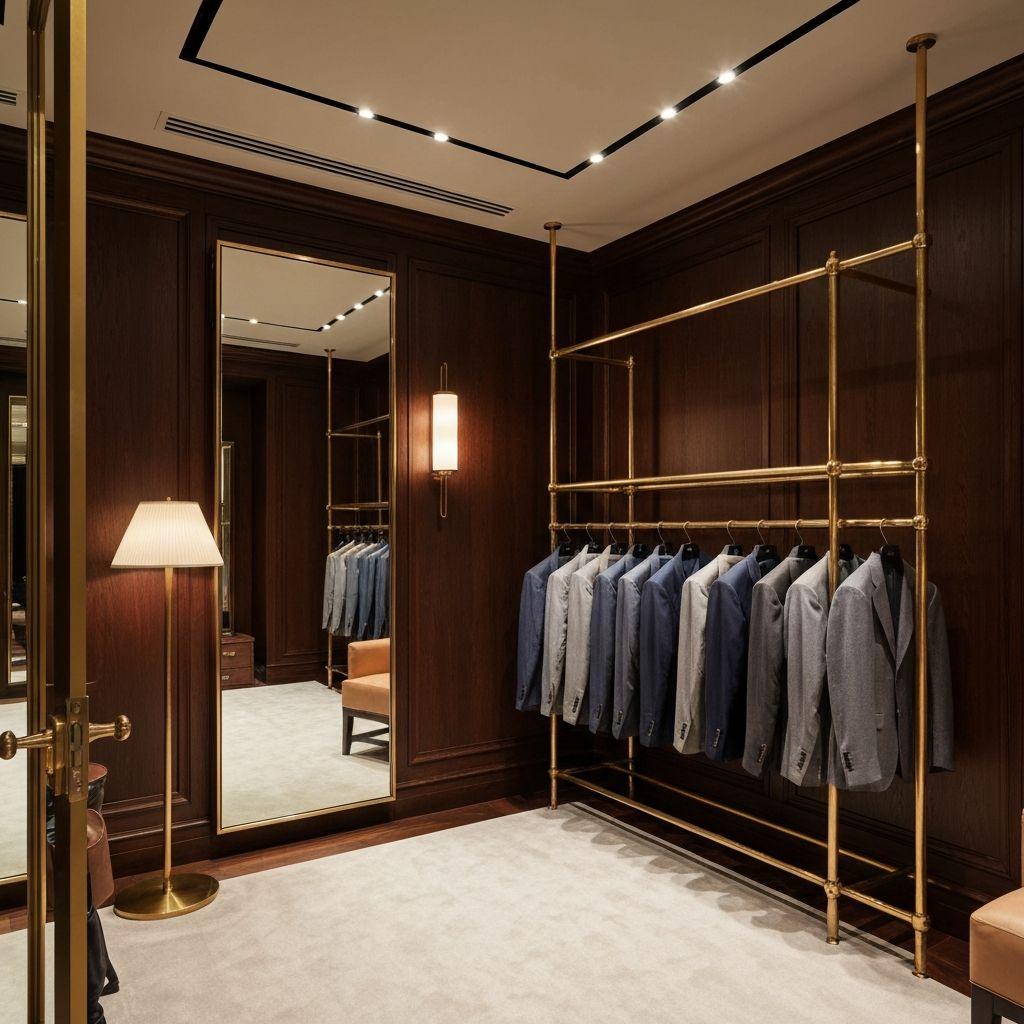
Hong Kong has no shortage of shops that will measure you on Monday and hand over a suit on Friday. That is a legitimate business, but it is not bespoke tailoring, and the difference shows up about four months later, in the shoulders and the collar. Here is how to tell them apart before you pay a deposit: what to ask, what a real fitting should feel like, and the signals that the person measuring you is a sales desk rather than a tailor.
What the word bespoke actually commits a tailor to
Bespoke is not a price bracket. In a working atelier it means a specific set of promises, and you are entitled to hear each one confirmed out loud.
- A paper pattern cut for you alone. Not a stock block adjusted at the seams. It is drafted from your measurements and kept, so a second order starts from your own shape.
- Thirty or more measurements, including the awkward ones. Chest and waist are the easy part. Posture, shoulder slope, one shoulder lower than the other, a forward neck, a hollow back: these decide whether a jacket hangs cleanly, and they have to be written down, not remembered.
- A floating canvas in the chest. The canvas is the layer that gives a jacket its shape. Floating means it is hand-stitched rather than glued, so it moves with you and moulds to your chest.
- Time. A true bespoke suit is fifty to seventy hours of hand work and six to eight weeks. Made-to-measure, a different and perfectly respectable service, runs three to four weeks.
- More than one fitting. The first is a baste: the garment is held together with white basting thread so it can be taken apart and re-cut. Nothing is finished then, and it should not look finished.
Questions worth asking before you leave a deposit
A good tailor answers these without flinching, and the answers tell you more than any brochure. Ask in the shop, not by email.
- Who cuts the pattern, and who does the fitting? In a small atelier it is often the same person. Where work is farmed out, the person who measured you may never see the garment again.
- Will you note my posture and shoulder slope? A vague answer means the jacket is being built for an average body that does not exist.
- How many fittings are included, and what happens at each? Two is the minimum for a first commission. Three is common.
- Where is the garment actually made? "Our workshop" only counts if they can tell you where it is.
- Can I see the canvas? A tailor with nothing to hide will open a jacket and show you the floating layer and the pick stitching on the lapel edge.
- What is this cloth, and who wove it? The name on the selvedge matters less than weight and finish, but a shop that can tell you neither is selling a look, not a garment.
- What happens if the fit is still wrong at the final fitting? The answer should be "we take it apart", not "we can let it out a little".
How to judge a fitting
The first fitting is the most useful hour of the commission, and most first-time clients waste it apologising. The garment is unfinished and meant to look odd. Your job is to describe what you feel, not to be polite.
Stand naturally, then walk, then sit. A jacket pulling across the back when you reach forward has too little blade width. A collar standing away from your neck means the balance is wrong, and no pressing will fix it. Sleeves twisting toward the body have a pitch problem. Trouser hems breaking differently on each leg usually mean one hip sits higher, which is normal and should already be in your notes.
Say it plainly: "it pulls here when I do this" tells a cutter more than any technical term, and a tailor who listens will chalk the garment while you are still in it. If you are out of the fitting room in ten minutes, you are not being fitted; you are being confirmed.
Six red flags worth walking away from
- Measurements done in fifteen minutes, standing still, in your shoes. A proper session watches you move and asks how you sit at a desk.
- No basted fitting. If the first time you see the garment it is finished, you are buying made-to-measure at bespoke prices.
- No notes on posture or asymmetry. Ask directly. "We'll see at the fitting" means the pattern was cut before anyone looked at you.
- A price quoted before the cloth is chosen. Cloth is a large part of the cost; a number given at the door is a package, not a commission.
- Delivery promises that beat the physics. Six weeks for a hand-canvassed suit is already fast; two weeks means fused interlining and a factory.
- No interest in what you do in the suit. A jacket for court and one for a ballroom are cut differently; a tailor who does not ask is working from a template.
Price and value, without the numbers
Wanting to know what you pay for is reasonable; expecting a quote before the cloth is on the table is not. Compare what sits inside the price instead.
Two suits at the same price can hold wildly different amounts of labour: one with a hand-cut pattern, a floating canvas and two fittings with a re-cut between them; the other with a graded block, a glued interlining and one appointment that is really a collection. The first still fits in five years and can be altered twice. The second lasts a couple of seasons and cannot be taken apart. The honest comparison is price against the years the garment stays wearable, not price against price.
Cloth for a Hong Kong climate
Most first commissions fail at the cloth stage, not the cut. Hong Kong is hot for eight months and humid for most of them; a heavy worsted bought for its drape spends the year on the hanger.
For office wear, look at 250–280g wool or a wool-linen blend: it holds a crease without trapping heat. For winter, or a suit mostly worn in air conditioning and on planes, 320g and up behaves better. Fresco and high-twist cloths resist creasing, and an unlined back makes a real difference in July. A tailor who suggests it unprompted knows this city.
If you are a woman buying a suit here
Ladies' tailoring in Hong Kong is often treated as an afterthought, which is a shame, because the fit problems are more interesting. Shoulder width and armhole height decide whether a jacket reads as authority or as borrowed, and a high armhole with a shaped shoulder lets you raise your arm without the whole jacket rising with it. Bust shaping should come from a dart or a seam, not an oversized chest, and trousers need a different rise and hip curve from the men's block.
Ask the same questions you would ask for a man's suit, and expect the same answers. Our ladies' bespoke suits are cut on a separate block for exactly this reason.
See the process before you commit
Ask to see the workshop, ask to see a jacket opened up, and ask what happens between the first and second fitting. If a tailor cannot answer that, you have your answer.
The IB Tailors process page sets out our own sequence: measurements and posture notes, hand-cut pattern, baste, second fitting, final. Our men's bespoke suits follow the same route. Book a fitting at our Tsim Sha Tsui atelier and bring these questions with you. A good tailor enjoys being asked.