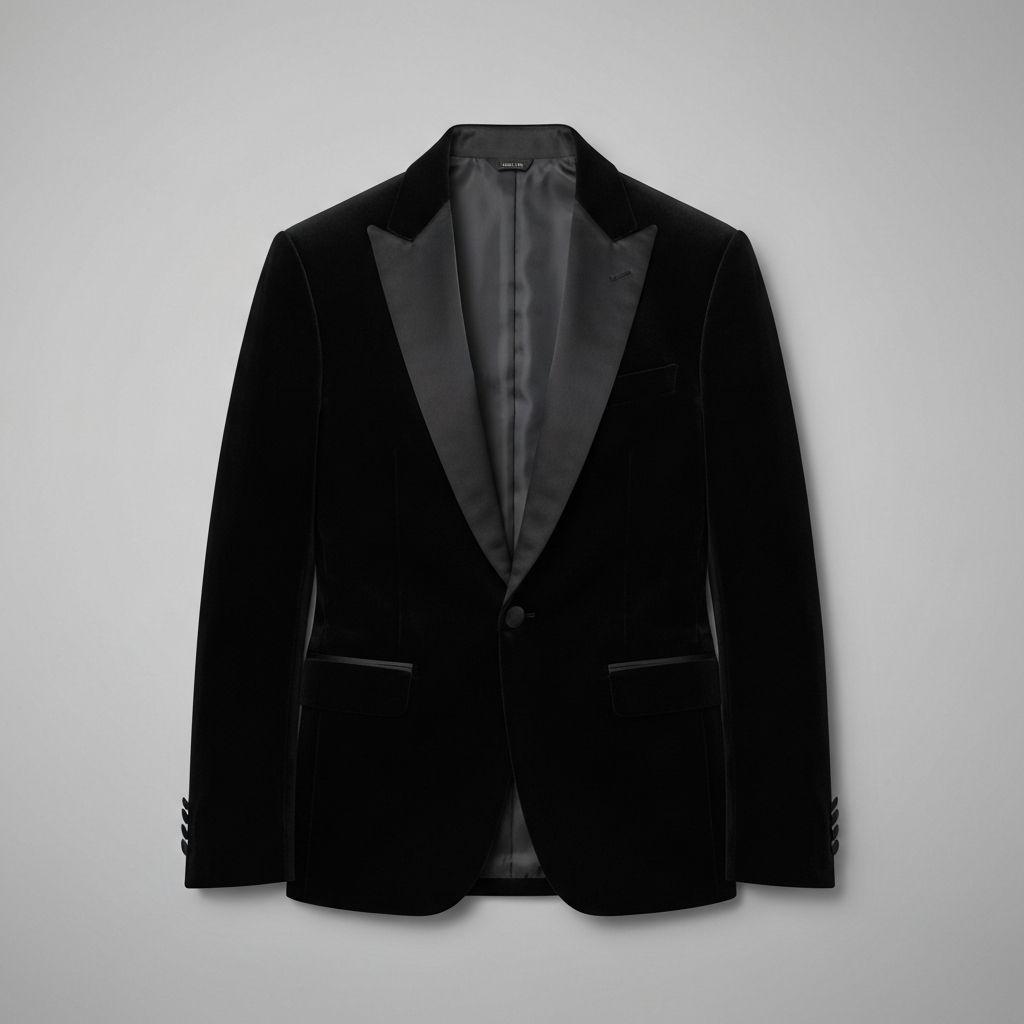
Black tie is the dress code most Hong Kong men almost get right. The jacket is close, the trousers are close, and then one detail gives it away: a shiny lapel that photographs like a rental, or a trouser hem sitting on the shoe like a business suit. This is a short guide to the decisions that actually matter, written from the cutting table rather than the invitation.
What black tie is actually asking for
A dinner jacket, evening trousers with a single braid down the outside seam, a self-tied black bow, and a shirt with studs or a fly front. Patent or plain polished oxfords. That is the whole uniform. Everything else, the lapel shape, the facing cloth, the number of buttons, is a choice inside those limits.
The common failure in Hong Kong is treating it as a dark suit with accessories added. A notch lapel, a long tie, a belt, a vented jacket with flap pockets, all of these read as office wear at 9pm. None of them are crimes, but none of them are black tie either.
Shawl or peak: the lapel sets the mood
The shawl collar runs in one continuous curve from the collar to the button. It is softer, it suits a narrower chest and sloping shoulders, and it forgives a man who is not built like a clothes horse. Wear it and the room reads it as relaxed confidence, closer to the 1930s than to a gala.
The peak lapel points upward and outward. It widens the chest, lengthens the line and looks more formal, which is why it survives on diplomats and men who enjoy being slightly overdressed. On a short neck or a very broad chest, keep the peak modest; a wide peak on a compact frame looks like a costume.
Notch lapels exist on dinner jackets in shops and rental racks in Tsim Sha Tsui. They are wrong in the strict sense. If you only wear black tie twice a decade that may not trouble you, but if you are commissioning, there is no reason to start from a compromise.
Grosgrain or satin facing
The facing is the cloth on the lapel, and it is the single detail people notice without knowing why.
- Satin is the high-shine option. It is correct for the most formal evenings, photographs with a hard white flare, and shows every wrinkle and every drop of humidity. In a Hong Kong ballroom in June it can look wet by the second hour.
- Grosgrain has a fine rib and a duller surface. It holds its shape in damp air, hides handling marks, and reads as expensive rather than bright. For most first commissions we cut grosgrain.
- Textured silk or barathea facing is the quietest option, for a man who wants the jacket to look like cloth rather than decoration.
Whatever you choose, the trouser braid should be the same cloth. A satin stripe against grosgrain lapels is the sort of mismatch that only tailors and photographers see, and both of them will see it.
Single or double-breasted
A single-breasted dinner jacket has one button and stays closed only at that button; it can be worn open, which matters in a warm room. A double-breasted dinner jacket is usually four buttons in a keystone arrangement and must stay closed, so it holds more heat and more shape. It flatters a taller, leaner man and gives a softer middle something to work with, but it is less forgiving after dinner.
For a first tuxedo in Hong Kong, single-breasted with side vents or no vent is the safer commission. A double-breasted jacket in a 300g cloth is a winter garment here, whatever the shop says.
What to specify in a first commission
Bring these to the first fitting as decisions, not questions. A tailor can guide you, but he cannot guess what you will be comfortable in at midnight.
- The facing cloth, and where it appears: lapel, collar, pocket jets, cuffs, trouser braid.
- Lapel shape and width, measured against your chest rather than a photograph.
- Vent style. Double-breasted: none. Single-breasted: side vents, or none if you like a clean back.
- Trouser rise. Evening trousers sit at the natural waist, higher than your business trousers, with brace buttons and no belt loops.
- Shirt collar. A turn-down collar is the modern, forgiving choice; a wing collar is more formal and less kind to a short neck.
- Pocket treatment. Jetted pockets with no flaps, and the jets covered in facing cloth.
- Buttons covered in the same silk as the facing, not plastic.
The mistakes we correct most often
Cloth that is too shiny and too light. A high-twist worsted with a sheen looks like a rented jacket under hotel lighting, and at 260g it creases into a map of the evening. A matte cloth with some body, or a wool and mohair blend for breathability, holds its shape through a long dinner in a humid room.
Trousers breaking wrong. Too long and the hem pools on the shoe, which drags the braid out of line. Too short and the stripe stops above the ankle. We cut evening trousers with a slight break or none at all, so the line of the braid stays unbroken from hip to shoe.
The jacket cut like a business suit. A dinner jacket is shorter, covering the seat but not the thigh, and it is closer through the waist. Copy the length of your office jacket and you will look like you are wearing one.
A belt under a waistcoat-less jacket. Braces, or side adjusters, nothing else.
Square-toed patent shoes and a pre-tied bow. Neither is expensive to fix, and both undo the rest.
How a tuxedo is built differently from a business suit
The difference is not decoration. Evening cloth is lighter and the jacket is worn in warmer rooms, in motion, late. That changes the construction.
The shoulder carries less padding, so the shape has to come from the canvas and the cut rather than from wadding. The chest is cleaner and the front is pressed to a softer roll, because a hard business press looks stiff under chandelier light. The facing is a second cloth of different weight and stretch, so it has to be basted on and the canvas underneath adjusted to carry it; on a fused jacket the two are glued together and the lapel eventually bubbles. We hand-stitch the lapel edge and the pocket jets, because silk facing marks under a machine.
The trousers are a different garment too: higher rise, brace buttons, no belt loops, a hand-applied braid, and a waistband that sits on the natural waist. If you want the full picture of how we cut a jacket, the same sequence applies to our bespoke suits, with evening cloth and evening proportions substituted.
Nothing here is exotic. It is a short list of decisions that most men are never told they are making. If you are commissioning a dinner suit for a wedding, a firm dinner or the next decade of them, start with the tuxedo collection, then book a fitting at our Tsim Sha Tsui atelier and bring your questions. We will also cut the evening shirt to match the collar and studs you actually want to wear.