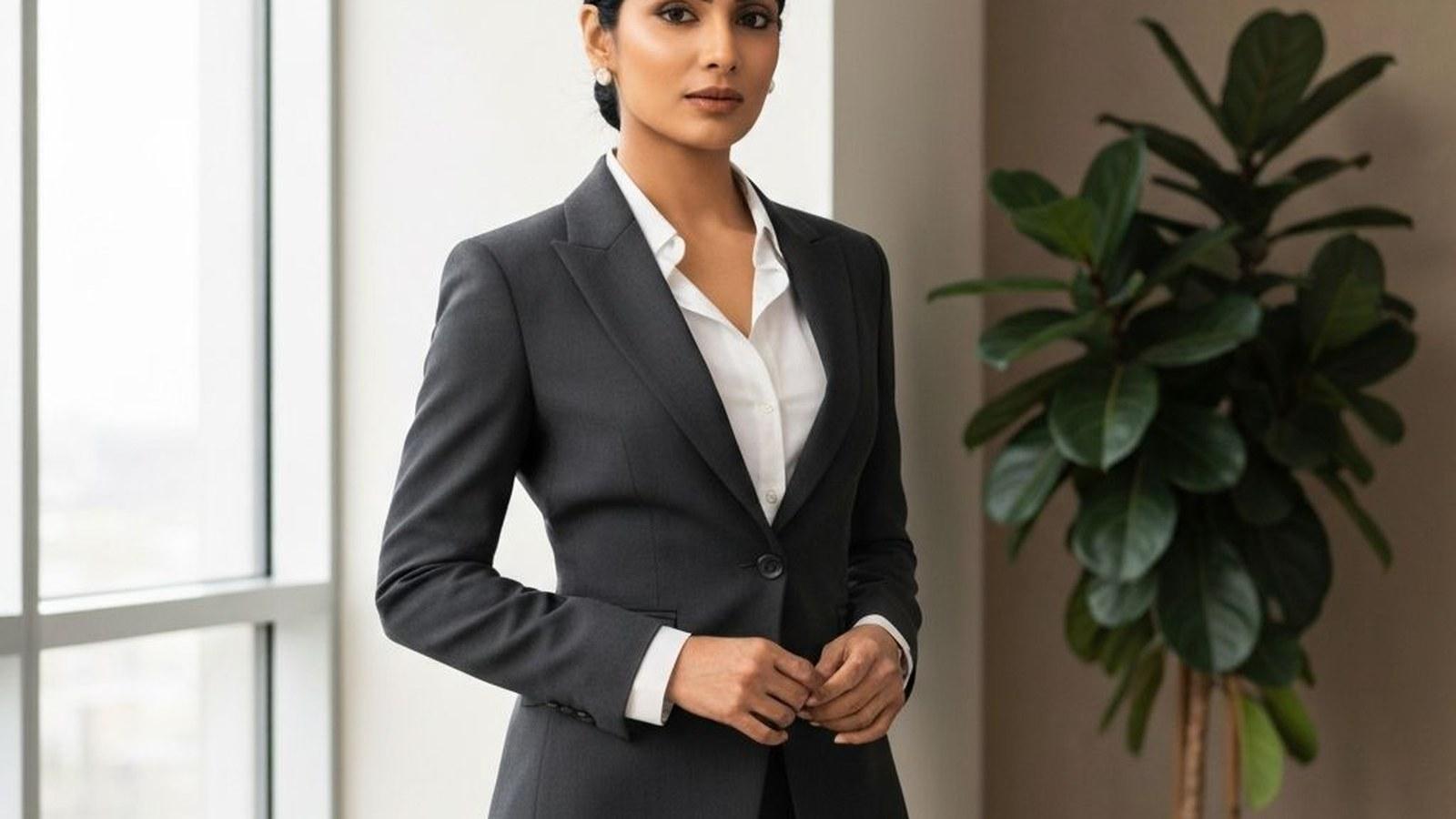
If you are buying a women's suit in Hong Kong, you have three routes: off-the-rack with alterations, made-to-measure, and true bespoke. Which one you need depends on how far your body sits from the factory pattern — and the shoulder almost always decides that.
What are the three routes to buying a women's suit in Hong Kong?
Off-the-rack means buying a standard size and having it altered. Made-to-measure means taking an existing block pattern and adjusting it to your measurements. True bespoke means cutting a pattern from scratch, by hand, for one person. Most women's suits sold in Hong Kong are scaled down from men's blocks, which is why the shoulder and the chest are the first places things go wrong. Each route has a ceiling, and the ceiling is set by the shoulder.
What can an off-the-rack chain actually fix?
A alterations tailor can shorten sleeves, take in the waist, hem trousers, and sometimes take in the back. What they cannot do is move the shoulder. If the shoulder seam sits past your shoulder point, the jacket collapses at the sleeve head; if it is too narrow, the seam digs into you. Taking in a waist is easy. Moving a shoulder is not, because there is rarely enough seam allowance and the sleeve head is already set. Jacket length can be shortened a little, but the pockets and vents usually run out of room after two or three centimetres. Trouser rise is the same story: if the crotch is wrong, hemming will not save it. Off-the-rack only makes sense when the shoulder already fits.
What can made-to-measure fix, and what can it not?
Made-to-measure adjusts an existing block to your measurements. Shoulder slope can be corrected within reason, jacket length can be set to your proportion, trouser rise can go up or down, and the waist and sleeves can be shaped. The limit is the block itself: you are still using the factory's shoulder shape, armhole depth and balance. If your shoulders are noticeably uneven, your posture is unusual, or your torso is unusually short or long, the fitter can only nudge it. Delivery is typically three to four weeks with one or two fittings. It suits women whose bodies are close to the block and who want cleaner lines without the full bespoke process.
When do you need true bespoke?
True bespoke starts with a hand-cut paper pattern and more than thirty measurements, including posture, shoulder slope and asymmetry notes. The shoulder can be placed on your actual shoulder line, jacket length can be set from your leg line, trouser rise can be cut from your natural waist and seated position, and the front and back can be balanced against each other. If your body is far from a standard block, if you want a specific silhouette, or if you intend to wear the suit for years, this is the route that gets you there. The cost is time: six to eight weeks, several fittings, and roughly fifty to seventy hours of handwork in a fully canvassed jacket. The first fitting is a baste — a rough garment with room to correct.
Why does the shoulder decide everything?
The shoulder is the one part of a suit that cannot be taken in or let out. It carries the whole garment. If the shoulder line is wrong, the collar lifts, the chest pulls, the sleeves hang off, and no amount of waist suppression hides it. A tailor can take in a waist in an afternoon. Moving a shoulder means recutting the yoke, the armhole and the sleeve head — work that often costs more than starting again. So at a fitting, look at the shoulder first. Everything else is secondary. A suit with a good shoulder and an average waist can still be saved; a suit with a beautiful waist and a bad shoulder cannot.
What should you look at in the mirror during a fitting?
Wear the clothes you normally wear to work. Stand naturally; do not pose. Check the shoulder seam: it should sit right at the edge of your shoulder, neither past it nor pulled in. Check the collar: a gap at the back of the neck means the shoulder or the balance is off. Check the sleeve pitch: with your arms hanging naturally, the sleeve should hang clean, not twist. Jacket length should cover your seat or the top of your hips, depending on the style. The trouser rise should sit at your natural waist, not pull under the crotch. Walk a few steps and sit down. In a good fitting the back shows no X-shaped wrinkles and the buttons do not pull. If the jacket rides up when you move, the balance is wrong — that is not a waist problem.
What should you ask before paying a deposit?
Ask what the price includes: how many fittings, whether final alterations are included, and what happens if the shoulder cannot be corrected. Get the delivery date in writing. Look at cloth samples in daylight, not only under shop lighting. A tailor who talks about your shoulder, jacket length and trouser rise before taking a deposit is telling you how they work. One who only talks about the label is telling you something else. A deposit is not a promise of a garment you have not tried on; it is a promise of a process you understand.
Where can you try a women's suit in Hong Kong?
Our workshop is in Tsim Sha Tsui, and we have been making suits for women since 1962. We offer both true bespoke and made-to-measure, and we will tell you honestly which route suits your body. Start with women's bespoke suits, look at the jackets and coats we make, or book a fitting at our Tsim Sha Tsui atelier. The first meeting is private, and the first thing we look at is your shoulder, not the cloth.