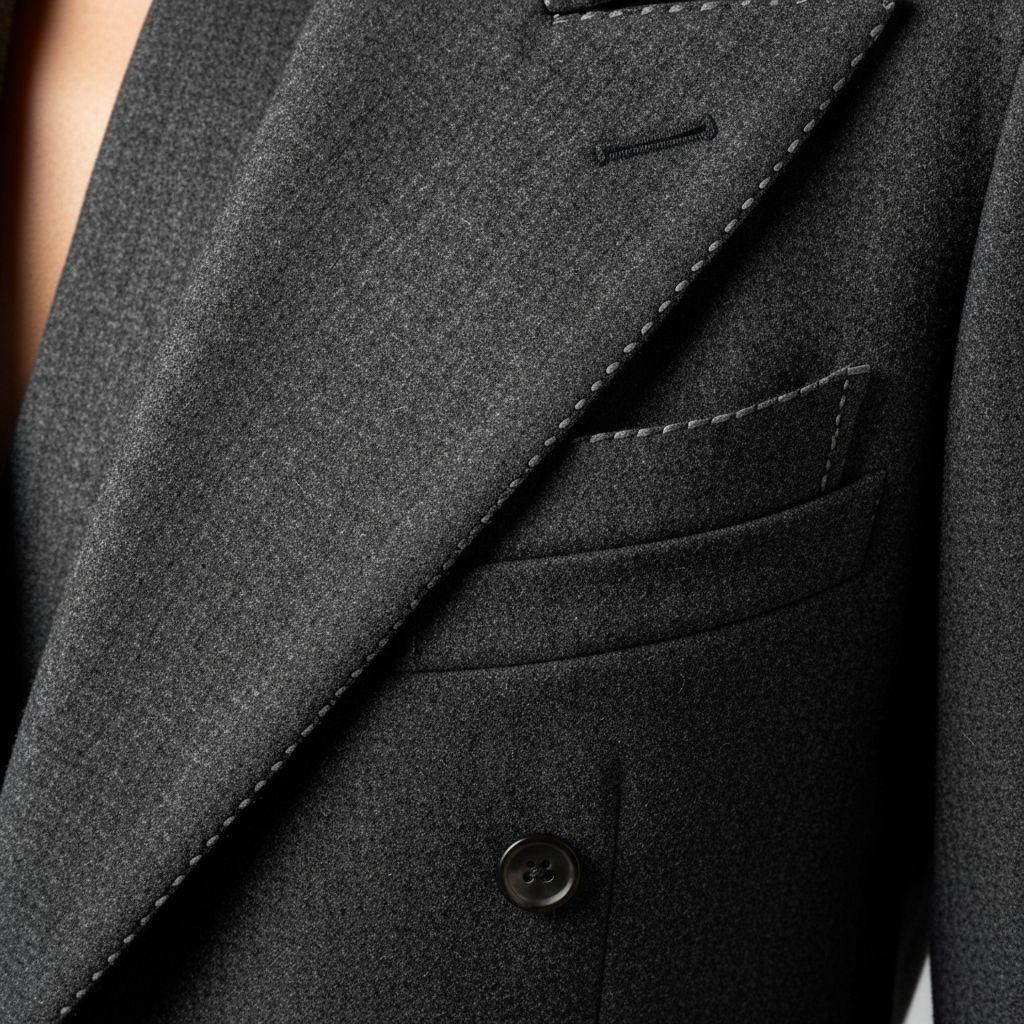
A women's blazer is the hardest thing in a wardrobe to buy well. A centimetre too much shoulder and the whole line collapses; two inches too much length and the legs lose a head of height. Most women try on ten jackets and settle for one that is "close enough" — and close enough is visible to everyone, not least to the wearer. Here is the order in which a tailor reads a jacket, from shoulder to cloth, so you have something to judge by in front of the mirror.
Start with the shoulder line
The shoulder seam should sit on the edge of your own shoulder bone. Not beyond it, not inside it. Too wide and the sleeve head collapses into a hollow, so the whole jacket lifts when you raise an arm. Too narrow and the shoulder is pinched, the armhole bites, and the shoulder reads as round rather than square.
Most ready-to-wear jackets are cut to one shoulder slope, which suits almost nobody. In Hong Kong the common pattern is a sloping shoulder combined with one side sitting lower than the other — usually the right, from carrying a bag. A tailor records the slope, the asymmetry and how much you stoop, then adjusts the shoulder pad rather than simply taking in the armhole. This is also why an alterations shop cannot fix it: the shoulder is set at the cutting stage, not the fitting stage.
Length is a proportion decision, not a fashion one
The hem usually lands at the widest part of the hip, or roughly a third of the way down the seat. On a single-breasted jacket, the classic check is the first knuckle of the thumb with the arm hanging loose. Under about 155cm, anything longer starts to eat the leg line. Taller frames can carry the hem to below the seat.
Sleeve length ends at the wrist bone, showing half an inch to an inch of shirt cuff. One thing worth knowing before you commit: shortening the body moves the pockets with it, and pockets that sit too low make a jacket look borrowed. Decide the length at the pattern stage.
Single-breasted or double-breasted
Single-breasted, one or two buttons, is the working jacket. It sits open, it survives a whole day at a desk, and it works over trousers and a skirt alike. Double-breasted draws the waist in and broadens the shoulder line, which is flattering in a photograph and demanding in real life: the buttons are fixed, so the waist is fixed, and a short torso or a fuller bust has nowhere to go.
That fixed geometry is exactly why double-breasted rewards bespoke. Ready-to-wear places the buttons for an average body; you spend the day accommodating the jacket instead of the other way round.
Lapels: notch, peak, shawl
Notch is the default for good reason — it disappears into a working wardrobe and never looks like a costume. Peak sweeps upward and widens the chest; on a woman's jacket the peak should be narrower than on a man's, or it reads as borrowed. Shawl has no notch at all, just one clean curve down to the button, and it is the evening and graduation-dinner lapel. None of the three is better. They answer different questions about occasion and frame.
Cloth weight, and the Hong Kong problem
Thirty-three degrees on Hankow Road, eighteen degrees in the office. That is the real brief for a jacket in this city, and it rules out most of what looks good in a lookbook.
For summer, 250–280g wool fresco or a high-twist worsted is the practical answer: dry to the touch, holds its shape, resists creasing through a full day of sitting. Save 320g and above for winter or evening. A half lining or no lining at all is noticeably cooler, but only if the cloth is dense enough to hang on its own. Wool-polyester blends are cheaper and tougher, and from three metres away you cannot tell; after two summers of wear, you can.
The work jacket and the graduation-dinner jacket are not the same jacket
For work, stay quiet: navy or charcoal, single-breasted, notch lapel, something you can wear thirty times a season without anyone remembering it. For a graduation dinner you can take a risk — shawl collar, a darker double-breasted, a cloth with a little surface. But it is rarely worth buying a jacket for one night. Choose a colour and lapel that do both, then change the shirt underneath: a silk shell turns the same jacket into evening wear, which is a better use of money than two purchases.
Where bespoke actually differs from ready-to-wear
Ready-to-wear changes measurements. Bespoke changes structure. Armhole height, the curve of the collar, shoulder slope, the position of the waist — all of that is decided when the cloth is cut. An alterations tailor can shorten a sleeve and take in a waist; moving a shoulder or re-cutting a collar is not realistic.
The trade-off is time. Made-to-measure runs about three to four weeks; true bespoke, six to eight, with one or two fittings in between. At those fittings the tailor marks the jacket on your body in chalk rather than trusting a number on a form. What you are buying with those weeks is a shoulder that finally sits where it should.
If you want to know which of these applies to you, look at our women's jackets and coats and ladies' bespoke suits, then book a fitting at our Tsim Sha Tsui atelier. Bring the jacket you wear most often — the one that is almost right. The tailor will tell you exactly where it isn't.