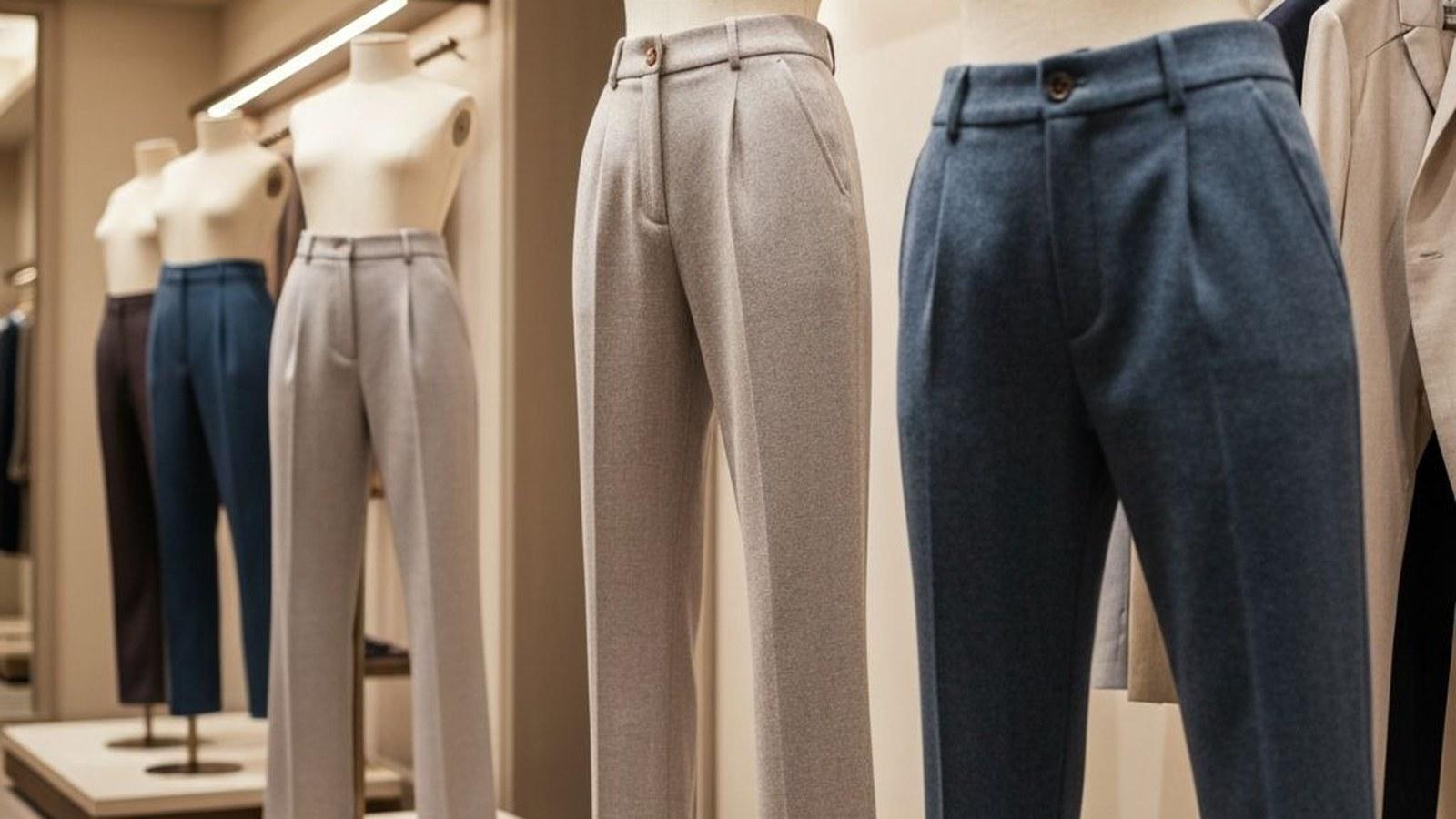
Women's tailored trousers should sit on the natural waist or a finger above it, with the fork cut to your actual crotch depth, enough ease through the hip and thigh to sit down and climb stairs, and a hem that skims the shoe. Most ready-to-wear pairs miss by an inch because they are graded from a standard block, not cut from your body. We have cut trousers for women at our Tsim Sha Tsui atelier since 1962, and the same few decisions separate a pair that looks tailored from one that looks borrowed.
Where should the waistband sit on women's trousers?
The waistband belongs on the natural waist, the narrowest part of the torso, usually level with or just above the navel. A high rise sits one finger above that point. What matters is the relationship between waistband, back waist and seat: the band should hug the back waist when you stand and stay put when you sit, without a belt doing the work.
If the waistband sits on the hips, the trousers slide down through the day and the fork becomes shallower. Women usually carry a larger waist-to-hip difference, so the compromise is harder. A band that fits the waist can be tight across the seat; one that fits the seat leaves a gap at the back. Taking in the waist treats the symptom; the pattern has to be cut for the difference, which is why we ask about rise before the cloth is cut.
How deep should the fork be?
The fork is the crotch depth, measured from the waistband down to the crotch seam. It is the measurement ready-to-wear gets wrong most often. Cut it too shallow and the front pulls, the pockets flare open and the seat feels tight. Cut it too deep and the crotch hangs low, the legs look shorter and the cloth folds as you walk.
We measure the fork with you seated, because the pelvis tilts when you sit and a standing measurement flatters almost everyone. The tailor also notes how you sit, whether your pelvis tilts forward or back, and whether one hip sits higher than the other. Two women with the same waist and hip can need different fork depths.
How much ease should there be through the hip and thigh?
Enough to sit down, cross your legs and climb a flight of stairs without the cloth pulling across the front of the thigh. Not so much that the seat bags when you stand up or the knee breaks into horizontal folds. The practical test is a chair and a mirror: sit, then stand and see if the cloth falls back into line.
A slim leg needs more careful easing at the seat and upper thigh, because there is less cloth to hide a tight curve. A wide leg relies on drape, so the ease has to be distributed rather than concentrated. In Hong Kong humidity, excess ease clings; a lining to the knee helps the trouser move over the leg instead of sticking. Ease is not looseness. It is the room the cloth needs to do its job.
What break and hem width should you ask for?
The break is how the hem meets the shoe. No break means the hem skims the shoe with no fold. A slight break gives one soft fold at the instep and is the most versatile choice. A full break, with the hem resting on the shoe, is traditional but can look heavy. For women's trousers, a slight break or no break is usually the cleanest line, especially with a heel.
Hem width should follow the leg line. A slim trouser tapers toward the ankle; a straight leg stays straight from knee to hem; a wide leg falls wide and needs enough cloth to swing. Do not choose the width from a photograph. Bring the shoes you wear most and let the hem be drawn with them on. We leave a hem allowance and mark the final length at the last fitting, not at the first.
Why do ready-to-wear trousers always miss by an inch?
Ready-to-wear trousers are cut from a standard block and graded up and down in fixed proportions. The rise, the fork, the hip line and the thigh all move together, whether or not your body moves that way. A size that fits your waist may be too shallow in the fork; a size that fits your seat may leave a gap at the back waist. The inch is the accumulation of those compromises.
Alterations can take in a waistband, shorten a hem or taper a leg. They cannot recut the fork, reshape the hip curve or move the pocket. Once the cloth is cut, the geometry is fixed. That is why a pair that feels right in the shop can feel wrong after a day at a desk.
What should you ask for when commissioning a pair?
Ask for side adjusters instead of belt loops. A side-adjuster tab lets the waistband follow the body and keeps the waist flat under a jacket; belt loops add bulk and pull the band lower. Ask for a lined waistband and flat pocket bags, so the hip line stays smooth. Ask for the lining to the knee, which helps the drape, reduces cling in humidity and protects the cloth from friction.
Ask for the rise you want before the pattern is cut. Ask for the hem width and the break in plain words, and bring the shoes. Ask the cutter to note a back-waist gap, a flat seat or a fuller thigh on the pattern, not to fix it later by taking in the centre seam. These are ordinary requests in a bespoke atelier. None is an upgrade; they are the difference between a pair cut for you and a pair adjusted toward you.
How does the fitting sequence correct the trousers?
True bespoke takes six to eight weeks. The first baste is pinned and chalked: the cutter corrects the fork, the seat, the waist and the thigh while the trouser is still open. The second fitting checks the cloth and the balance. The final fitting sets the hem, the pockets and the finish. Made-to-measure takes three to four weeks and starts from an existing block, so the corrections are real but narrower.
We take more than thirty measurements per client, including posture, shoulder slope and left-right asymmetry, and keep a permanent fitting profile for repeat orders. That profile is why a second pair is easier than the first, and why we ask you to sit, stand and walk in the fitting room rather than turn in front of the mirror.
What cloth works for trousers in Hong Kong?
For summer, a tropical wool around 250 to 280 grams is the safe choice: light enough to breathe, firm enough to hold a crease and recover after a long day. For winter, 320 grams and up gives cleaner drape. Fresco, wool crepe and wool-linen blends work well in the humidity because they move with the body instead of clinging. A very light cloth collapses in a wide leg; a very stiff cloth stands away from the shoe in a slim leg.
We keep a library of cloths from houses such as Zegna, Loro Piana, Scabal, Holland & Sherry and Vitale Barberis Canonico. The right cloth is the one whose weight and weave match the shape and how you will wear it.
If you want to know how close a pair of trousers can get to your body, book a fitting at our Tsim Sha Tsui atelier. The consultation is a private sixty-minute session, with tea or coffee, a minute from The Peninsula. Start with our women's tailored trousers page, look at ladies' bespoke suits, or book a fitting.